
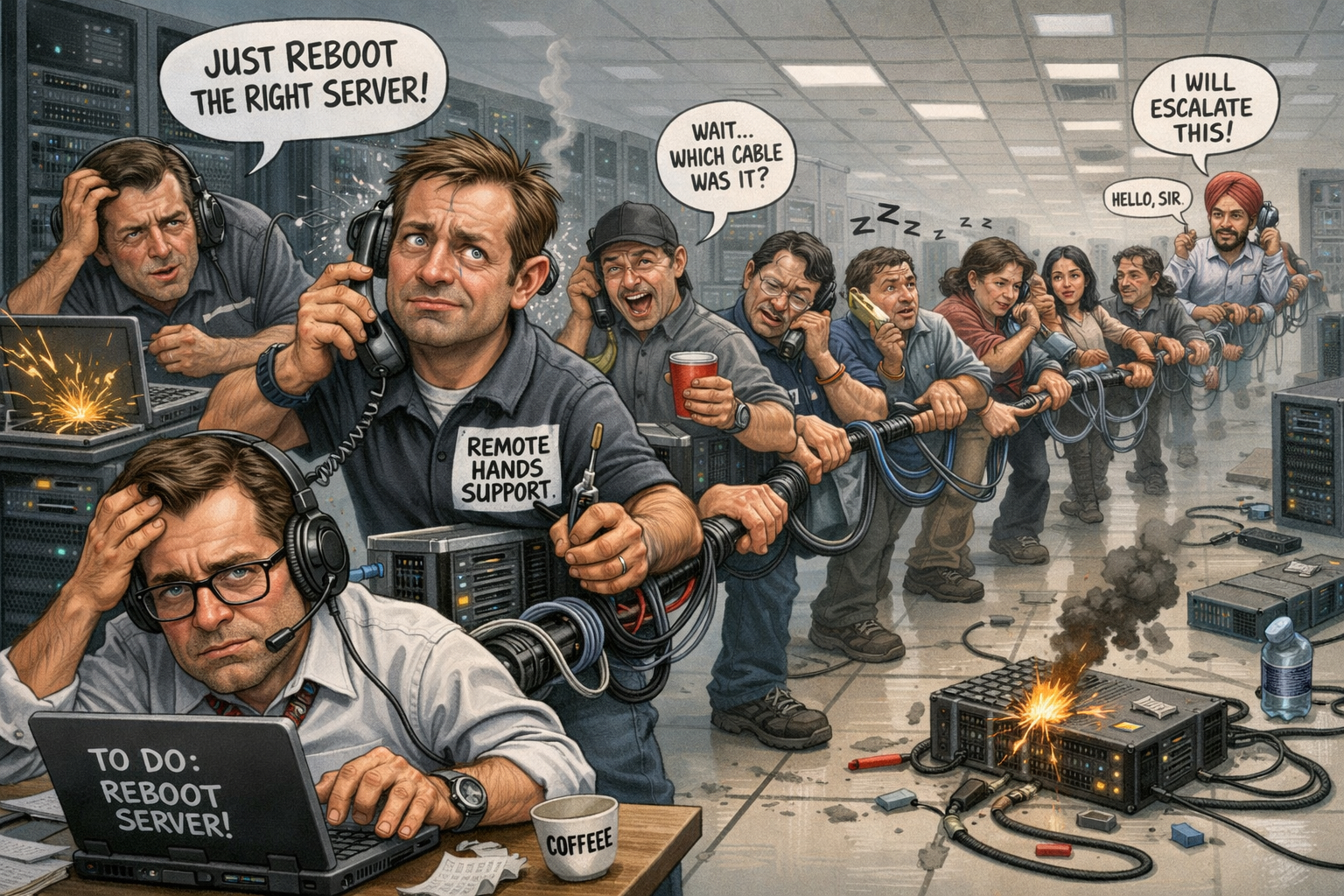
In the fast-paced world of data centres, Remote Hands support should be seamless, efficient, and reliable. When something goes wrong—be it a faulty cable, a failed server, or a downed PDU—you want a skilled engineer on the ground, acting with urgency and precision. But what if that engineer isn’t who you think they are? What if the company you’ve entrusted with your infrastructure is just one link in a much longer chain?
Outsourcing isn’t new. It can drive cost efficiencies and help organisations scale. But in the world of Remote Hands, it can also introduce risk—especially when the company you hire is outsourcing the service again. Sometimes even a third time. It’s a chain that can quickly become tangled.
We’ve seen it firsthand in our years on the ground in data centres across the globe. A company contracts a Remote Hands provider. That provider doesn’t have a local presence in the region, so they subcontract to another firm. That firm, in turn, may rely on freelancers or additional subcontractors. By the time the engineer arrives on-site, they may be three layers removed from the original agreement—and critically, from the expectations you set.
At that point, you’re not just dealing with a technician. You’re dealing with a game of telephone.
Each additional link in the chain adds complexity. Here’s where things start to go wrong:
In RFPs and sales decks, it all looks clean. You sign a contract with one name, one logo, one platform. But behind the scenes, the delivery model might tell a different story.
We’ve seen Remote Hands vendors pitch “global coverage” but operate more like brokers than service providers. It’s a model optimised for margins, not for reliability. And unless you ask the right questions, you may never know.
"Who is actually going to be touching my hardware?"
"How are they trained? How are they supported?"
"How are they affiliated to your company?"
These aren’t just due diligence questions. They’re the difference between service you can depend on, and service that depends on luck.
At B-612, we’ve taken a fundamentally different approach.
Our global engineering network is built on trust, not layers. While our engineers are subcontractors, we do not outsource our Remote Hands work to third-party agencies or brokers. Instead, we hand-pick every engineer ourselves, vetting them rigorously, training them extensively, and supporting them as if they were part of our internal team.
They’re not just “on our books”—they’re part of our DNA.
We know their capabilities, we invest in their growth, and we continuously align them with the standards our customers expect. Most of our engineers have 5 to 10+ years of Data Centre experience, and many have been with us for years, supporting deployments across 600+ sites worldwide.
Of course, there are rare exceptions. In regions like France and the Nordics, we collaborate with long-standing partners we’ve worked with for over 15 years. These are trusted relationships built on shared standards and mutual accountability.
This consistent, hands-on approach pays off—not just in speed and precision, but in results. Our customer satisfaction rates are among the highest in the industry, and it’s not by chance. It’s because our customers know: when B-612 is on-site, we take ownership.
Remote Hands shouldn’t be a gamble. And it certainly shouldn’t involve navigating a chain of subcontractors to get the support you’ve already paid for.
At B-612, we believe in transparency, accountability, and quality you can trace back to us—every time. When you call us, you get us. Not a middleman. Not a third-party. Just a hand-picked professional, backed by a company that lives and breathes Remote Hands.
So before you sign that next contract, ask:
Who’s actually going to be on the other end of the cable?
If you found this article helpful and want to learn more about how our expert team can support your infrastructure, we’d love to hear from you.
Specialised in managing network infrastructure in data centres on behalf of a wide range of colocation users, B-612 offers a comprehensive suite of tailored Remote Hands & Eyes solutions designed to drive service availability up and network management costs down. Get in touch today to discover how we can support your operations


